Cement

High Standards in the Cement Industry
Cement production is a classic high-load process. Raw materials such as limestone, clay, and marl are crushed, dried, ground, and sintered into clinker in a rotary kiln at temperatures of around 1,450 °C. Cement production accounts for about 8% of global CO2 emissions, making cement manufacturing a key lever for reducing emissions in the construction sector.
For OEMs and operators, this means that filtration solutions must function under extreme conditions. These include high dust loads, abrasive particles, temperature spikes, mechanical wear, and chemical stresses. Filters installed on crushers, raw mills, clinker coolers, coal mills, cement mills, silos, and loading equipment are particularly critical in this context.
- High temperature resistance
- Low differential pressure
- Long service life
- Reliable compliance with emission limits
- Robust design for abrasive and fine dusts
- Easy maintenance and high operational reliability
Talk to us about your application in the cement industry.
Together, we’ll identify the right filtration solution for your plant—whether it’s a new installation, a retrofit, or a replacement part.
Benefits
- Large filter area in a compact design
- Longer service life and less maintenance
- Reduced differential pressure and lower energy consumption
- Reliable emission reduction even with abrasive dust
- Efficient retrofit for existing systems
Product Line
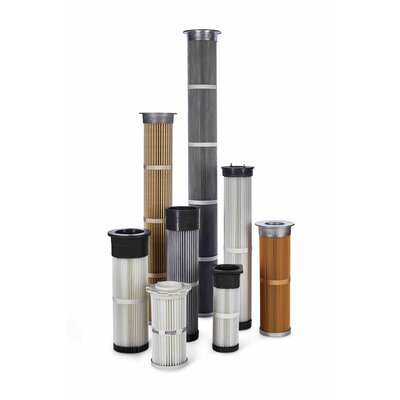
High-Performance Filters for Your Cement PlantPleated bag filters offer a high-performance and cost-effective solution for demanding dust collection applications. Thanks to their pleated geometry, large filter area, and efficient surface filtration, they enable longer service life, lower differential pressure, and reduced emissions. In the cement industry, they stand out for their robust performance, easy maintenance, and contribution to lowering the total cost of ownership.


Filter Media
Product Differentiation Through Filter Media Options and CoatingsOur various filter media options and coatings have been specifically designed to meet the unique challenges of different industries and ensure optimal filtration performance, extended service life, and improved safety in demanding operating environments.
Cement Manufacturing Process
Efficient Dust Removal Throughout the Entire Value ChainProcess

Dust Collectors in the Process Stages of a Cement Plant
1. Quarry
Raw materials such as limestone, clay, and marl are extracted at the quarry and prepared for transport to the plant. Generally, there are no dust collection systems.
2. Crusher
In the crusher, the raw material is crushed into smaller, manageable particles. A dust collector may be installed here to extract dust from the crusher, the conveyor belt, and all transfer points. (Transfer point = the point where material is transferred from one system to the next.)
3. Pre-homogenization
Various raw materials are temporarily stored and mixed here to achieve the most uniform composition possible.
Although not typical, some plants may have a general dust extraction system that removes dust from the hall where the material is stored and pre-homogenized.
4. Raw Meal Mill
In the raw meal mill, the raw materials are finely ground to produce a homogeneous raw meal for further processing. A large dust collector is almost always installed here to extract dust from the mill as well as from all transfer points, such as conveyor belts, bucket elevators, etc.
5. Raw Meal homogenization
The raw meal is temporarily stored in silos and blended to compensate for fluctuations in its composition. Typically, this involves a single silo that serves both to store and to blend the material. It is usually equipped with an integrated dust extraction filter at the top of the silo.
6. Preheating Tower
In the preheating tower, the raw meal is preheated by hot process gases before it enters the kiln. The preheating tower itself typically does not have a dust collector. The gases coming from the rotary kiln are directed to the main filter at the top of the preheating tower.
7. Furnace Exhaust Bypass
The furnace bypassdiverts a portion of the furnace exhaust gases away from the process to remove unwanted substances such as chlorine or alkalis. The duct used to remove chlorine and alkali compounds is typically equipped with cyclones and a filter.
8. Coal Mill
In the coal mill, the fuel coal is processed to the fineness required for combustion.The size of the coal mill can vary depending on the country and the proportion of coal used as fuel. A dust separator is installed in this area.
Alternative Fuel
For example, plastic grinding systems can be equipped with dust collectors on conveyor belts and grinding units, particularly when ATEX requirements apply.
9. Rotary Kiln
In the rotary kiln, the preheated raw mealis fired at very high temperatures and converted into clinker.Dust removal from the rotary kiln is carried out via a central filter. An important factor is the exhaust gas stream at the outlet of the preheating tower, which has temperatures ranging from approximately 300 to 380 °C. These gases are often cooled to 160 to 220 °C; electrostatic precipitators or pleated bag filters are then used at this point. Depending on the temperature range, suitable solutions can be offered in certain cases.
10. Clinker Cooler
In the clinker cooler, the hot clinker is rapidly cooled after firing, and some of the heatis recovered.A large pleated bag filter is typically installed here. Depending on the maximum operating temperature, suitable solutions can be offered in some cases.
11. Clinker Storage
After cooling, the clinker is temporarily stored before being processed further.Transfer points and silos may be equipped with a dust collection system or multiple dust collectors.
12. Cement and Clinker Grinding
Here, clinker is ground very finely along with other components to produce cement.This is one of the largest dust collectors in the plant. It can also handle dust extraction at transfer points.
13. Additive Silos
Additives such as granulated blast furnace slag, limestone, or fly ash are stored in these silos.These silos may be equipped with built-in filters for ventilation.
14. Cement Separation
During separation, the ground material is divided into fine and coarse fractions to achieve the desired product quality.Typically, a separate dust collector isprovided for the separator.
15. Cement Storage
The finished cement is stored in silos before it is packaged or loaded. The silos are typically equipped with built-in filters. In addition, there may be a separate dust collection system for the transfer points.
16 Lab
Raw materials, intermediate products, and finished products are tested and analyzed in the laboratory. The laboratory is typically equippedwith small dust collectors, eitherwith cartridge filters,pleatedbag filters, or Flat cell filters.
17. Bag-filling system
Here, the cement is bagged and prepared for shipment.Transfer stations and bagging machines are equipped with medium- or small-scale dust collection systems.
18. Bulk cargo loading station
At thebulk loading station, loose cement is loaded directly into silo trucks or other transport units.Transfer points and loading stations are equipped with amedium-sized or largerdust collection system, especially when there are many or large loading points.
Case Studies
Success Stories That Make an ImpactToday, our filters are used worldwide in a wide variety of applications and across numerous industries.
Let our case studies inspire you.
Success Stories
China
The challenge was to maintain the cement mill's production capacity while significantly reducing emissions. By installing a pleated bag filter with a large filtration surface area, cement grinding capacity was improved and emissions were reduced by 88 percent.


MyAirfiltration.com
Easy filter purchase. Increase efficiency.Discover the benefits of purchasing through myAirfiltration.com. On our platform, you can explore our complete range of air filters, place orders easily, and request custom filters with just a few clicks. Take advantage of advanced filter options and seamless communication with our team for all your needs.
Our Experts in Dust Collection Filters
Please contact us directly.
Filter by business area for "Process Air Filtration" and find the contact person in your region.
We'd be happy to advise you!
Please send us your inquiry.
Tell us more about your requirements. We'll help you find the right filtration solution for your dust collection system.
