Gas turbine filters for turbomachinery and gas engines
Gas turbines, gas engines, and compressors require clean intake air to operate reliably and at a consistently high level of performance.That is exactly what gas turbine filters do: They keep the intake air clean, thereby protecting the machine.

Hengst supplies a complete line of filter elements for this purpose: pocket filters, compact filters, filter cartridges, and filter mats. In addition, Hengst manufactures the filtration technology and the complete filter housings, so that a single partner can provide both the replacement elements and the entire system. Every Filter Element is manufactured in-house: Hengst develops and produces the elements itself—from individual filters to complete systems—drawing on more than six decades of filtration experience dating back to 1958 and supported by a global service network.
Benefits
- Filter Elements manufactured in-house, developed and produced within the Hengst Group since 1958
- Filter Elements for gas turbines of all sizes, from medium-sized units to large power-generation turbines
- Compatible with existing filter housings, with replacement and upgrade elements, including for housings from other manufacturers
- Global service—a family-owned filtration company with 33 locations around the world
Why Gas Turbine Filters Are Key to Performance and Operating Costs
A gas turbine draws in large volumes of ambient air, and everything carried by that air comes into contact with the rotating components. Dust and abrasive particles cause erosion on the compressor and turbine blades. Fine deposits accumulate on the blade surfaces (fouling), impairing aerodynamic efficiency and thus reducing performance over time. Dissolved salts combined with moisture—a typical challenge at coastal and offshore locations—can cause corrosion in the hot gas path. These same contaminants also shorten the service life of gas engines and compressors operating in the same environments.
The separation efficiency is only half the story. Every millibar of additional pressure drop at the intake reduces turbine output and increases specific energy consumption. The value of a gas turbine filter is therefore determined by two characteristics: how reliably it performs filtration and how consistently it maintains pressure drop over its entire service life. A Filter Element that keeps pressure drop low and stable preserves the machine’s design efficiency and keeps operating costs low. It is precisely here—far beyond the mere purchase price—that it is usually determined whether filtration is ultimately expensive or cost-effective.
Filter Elements and complete systems from a single source
This product group includes Filter Elements—that is, the replaceable parts located in the intake system of a gas turbine that perform the actual filtration. If you are operating an existing filter housing, Hengst supplies the appropriate replacement and upgrade elements, even for housings originally manufactured by other companies. If you need more than just the elements, Hengst also designs the filtration technology and the complete filter housing as a single system. This way, you have a single partner, whether you’re replacing elements or need a new system.
Are you looking for a complete filter system or a new filter housing instead of individual replacement elements?
Then take a look at our air intake filter systems.
Gas Turbine Filter Elements
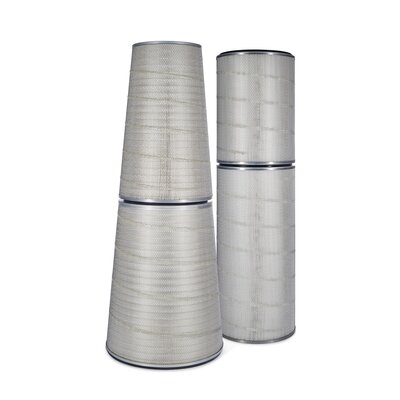
Hengst covers the entire filtration path of a gas turbine intake system: from coarse filtration at the weather protection louvers through fine filtration to the final stage, which protects the engine. filter mats handles coarse filtration and weather protection. pocket filter (Bag filters) form the pre-filter and fine-filter stages with high dust holding capacity. compact filter (V-Panel) provide a high degree of fine separation where installation depth is limited. Conical and Cylindrical Filter Cartridges are used in self-cleaning pulse filter systems (Pulse Jet) under continuously high dust loads. These element types can be combined into a multi-stage filter system tailored to the specific site and turbine. Additionally, an mobile test stand is available to check the remaining service life and condition of installed elements directly on site.






How to Choose the Right Gas Turbine Filter
When selecting gas turbine filters, the focus is less on a single “best” component and more on tailoring the filter system to the operating environment and the machine it is designed to protect. Three factors determine the decision.
Site Conditions and Air Quality
The operating environment dictates the requirements. Deserts and arid locations with high, persistent dust loads call for self-cleaning filter cartridges that continuously regenerate rather than becoming clogged and saturated. Coastal and offshore locations are characterized by salt aerosols and humidity, requiring water-repellent filter elements as well as an upstream pre-separation stage. For temperate inland locations with low to moderate dust loads, a multi-stage static filter system consisting of bag filters and compact filters is suitable. The particle size distribution, humidity, and salt load at the site collectively determine both the filter element type and the efficiency class.
A Comparison of Depth Filtration and Surface Filtration
Static Filter Elements use depth filtration: Particles penetrate the filter material and become trapped in its fiber structure. This achieves high efficiency ratings, and the pressure drop increases gradually as the element becomes clogged, until it is replaced. Self-cleaning filter cartridges use surface filtration: a dust cake forms on the cartridge surface and is cleaned off at regular intervals, which keeps the pressure drop consistently low even under high dust loads. Depth filtration generally achieves higher separation efficiency, while surface filtration is designed for consistently high dust loads where continuous regeneration is more important.
Separation Efficiency and Pressure Drop
A higher separation efficiency removes more of the fine particles that clog turbine and engine blades. However, separation efficiency and pressure drop must be balanced, because overfiltering at a clean site increases pressure drop without providing a corresponding benefit. Because a stable, low pressure drop over the entire service life maintains machine efficiency and limits energy costs, the element with the lowest total cost of ownership (TCO) is rarely the cheapest to purchase. Hengst’s application engineers determine the appropriate separation efficiency and filter length for each application based on your site profile, machine class, and dust load.
Filter Classes and Standards for Gas Turbine Filtration
Gas turbine Filter Elements are classified according to established filtration standards. This makes it possible to compare the separation efficiency across different suppliers and to match an element to a specific specification. Three classification systems are typically used.
| Standard | Class Range | Role in Gas Turbine Filtration |
| ISO 16890 | ePM1, ePM2.5, ePM10, Coarse | Current classification by particle size fraction; used for the design of pre-filter and fine-filter stages |
| EN 779:2012 | G4 to F9 | Coarse and fine filter classes; still widely used in existing specifications |
| EN 1822-1:2019 (EPA) | E10 to E12 | Efficiency classes for the final filter stage in gas turbine intakes; HEPA classes (H13 and higher) are rarely used due to their high pressure drop |
E10 through E12 are the efficiency classes typically specified for the final filter stage of a gas turbine intake system. These systems describe how a component is classified and compared. They serve as a reference framework for selecting the degree of separation, but do not replace the need to tailor the component to the specific site.
High product quality through development expertise and in-house manufacturing
The performance of a gas turbine filter system is determined by the Filter Elements inside it. Hengst develops and manufactures these elements in-house within the Hengst Group. This means that the most critical properties—such as pressure drop, dust holding capacity, and performance in humid conditions—are design parameters that Hengst directly controls, rather than properties of mass-produced, off-the-shelf components. It is a vertically integrated approach that spans the entire process, from the filter material to the finished element to the complete system.
The same manufacturing quality applies whether an element is installed in one of Hengst’s own filter systems or whether it replaces a worn-out element in an existing filter housing—even in housings originally manufactured by another company.
Industries and Applications
Hengst gas turbine filters protect rotating machinery wherever the quality of the intake air is critical to reliability and efficiency.
Energy Generation
Gas turbines and gas engines in base-load, peak-load, and combined-cycle power plants, ranging from medium-sized units to large power-generation turbines. Clean intake air minimizes fouling of the blades and maintains the machine’s rated output and heat consumption at the design level.


Frequently Asked Questions About Gas Turbine Filters
What types of filters are used in gas turbine intake systems?
Four main types of filter elements are used in gas turbine intake systems, usually combined into a multi-stage filtration system. Filter mats are used at the beginning of the system for coarse filtration and to protect against the elements. Pocket filters (bag filters) offer high dust holding capacity as a pre-filter or fine-filter stage. Compact filters (V-panel) provide high fine-particle separation efficiency in a flat design as a fine-filter or final-stage filter. Filter cartridges (conical and cylindrical) are used in self-cleaning pulse-jet filter systems for high-dust environments. The correct combination depends on the site conditions and the required efficiency class.
What is the difference between a Filter Element and a complete filter system?
A filter element is the replaceable component that performs filtration, such as a pocket filter, a compact filter, a filter cartridge, or a filter mat. A complete filter system, also known as a filter housing, is the housing and its associated components that hold the elements, guide the airflow, and, in self-cleaning designs, control the pulse-jet cleaning. Hengst supplies both: replacement elements for existing filter housings and complete systems for new installations. Operators who only need elements can order them directly; those who need the complete system can obtain it from the same partner.
What filter quality classes are used in gas turbine filtration?
Gas turbine filter elements are classified according to ISO 16890 (by particle size fraction: ePM1, ePM2.5, ePM10, and coarse), according to the older EN 779:2012 scale (G4 to F9), and according to EN 1822-1:2019 for EPA classes. E10 through E12 are the efficiency classes typically specified for the final filter stage of a gas turbine intake system. HEPA classes (H13 and higher) are rarely used due to their high pressure drop. These standards provide a framework for classification and comparison to select a component and match it to a specification.
Static or self-cleaning gas turbine filters—which one do I need?
This depends primarily on the dust load at the site. Static Filter Elements (bag and compact filters) use depth filtration and achieve high efficiency ratings; the pressure drop increases gradually until the element is replaced. This is well-suited for low to moderate dust loads and temperate climates. Self-cleaning filter cartridges use surface filtration: At regular intervals, a layer of dust is shaken off the cartridge, which keeps pressure drop low even under consistently high dust loads, such as in deserts and in heavy industry. The site’s dust profile and the machine’s sensitivity to pressure drop determine the choice.
How often do gas turbine filters need to be replaced?
Replacement intervals depend on the element type and the operating environment, not on a fixed schedule. Static elements accumulate dust over time and are replaced as soon as the pressure drop reaches a defined threshold. In dusty or contaminated air, this happens sooner; in clean, moderate environments, it happens later. Self-cleaning filter cartridges extend their service life because the pulse cycle continuously regenerates the filter surface. The practical benchmark is the pressure drop over the service life, not a calendar interval. Hengst’s application engineers will help you determine the right replacement time for your location.
Does Hengst supply replacement parts for filter housings made by other manufacturers?
Yes. Hengst manufactures replacement and upgrade Filter Elements for gas turbine intake systems, including for filter housings originally supplied by other manufacturers. The elements are manufactured at Hengst’s own production facilities using the same in-house-produced filter material as in complete Hengst systems. This allows operators to continue using an existing filter housing while upgrading the elements—for example, to a higher separation efficiency or a design with more stable pressure drop.
Who manufactures Hengst's gas turbine filters, and where do the Filter Elements come from?
Hengst’s gas turbine filters are based on Filter Elements that Hengst develops and manufactures in-house within the Hengst Group. The family-owned company was founded in Münster in 1958 and today employs more than 3,800 people at 33 locations worldwide. Since both the Filter Elements and the complete system originate from the same development and manufacturing organization within the Hengst Group, the properties critical to filter performance can be consistently controlled, rather than relying on purchased components.
